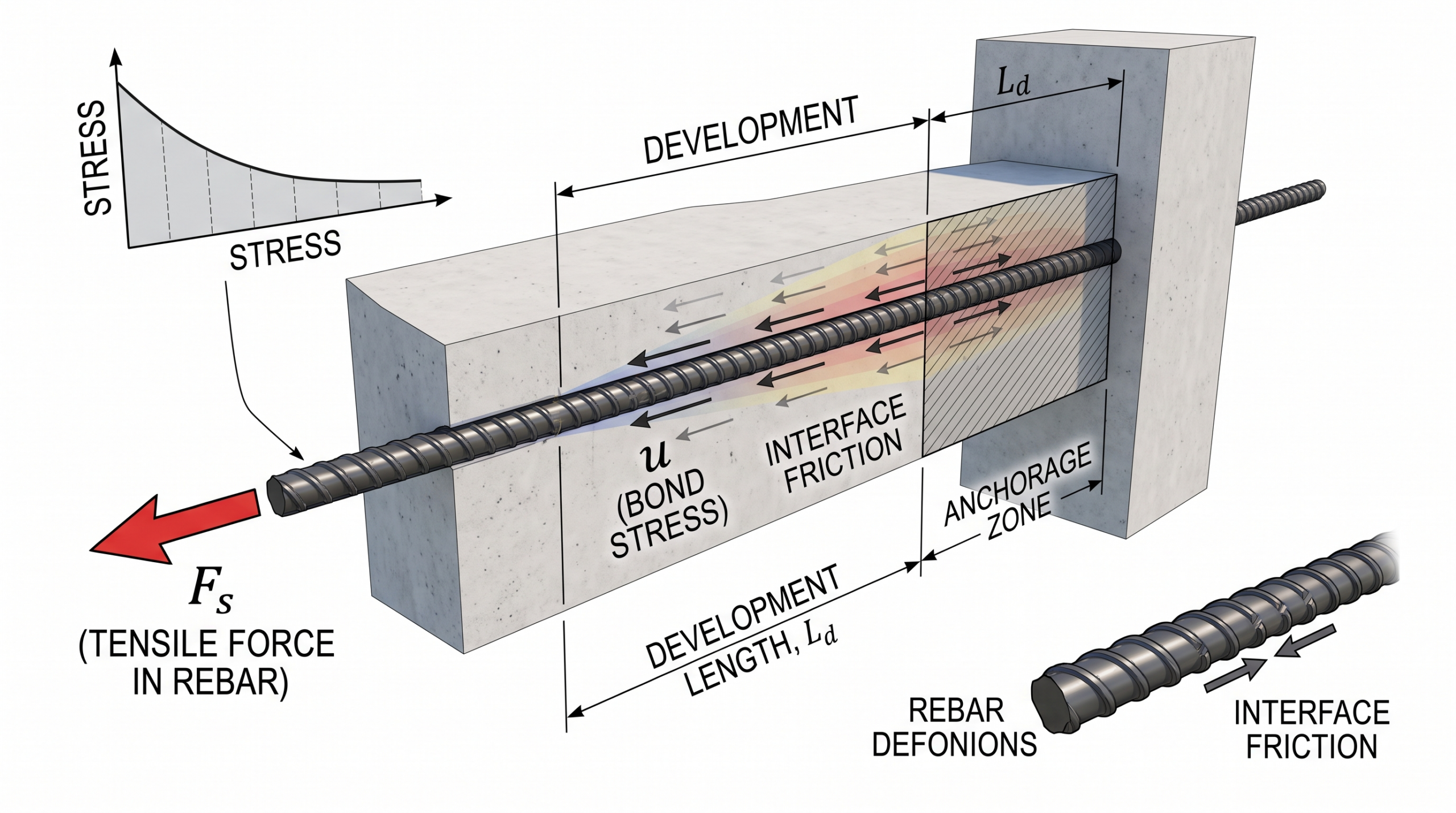
Rebar development length is one of the most important concepts in reinforced concrete design. However, it is also easy to overlook when you first start designing beams, slabs, columns, and foundations.
A reinforcing bar does not transfer its full force into concrete immediately. Instead, it needs enough embedded length to develop that force through bond with the surrounding concrete. Therefore, simply placing the correct amount of reinforcement is not enough.
Engineers must also make sure that each bar has sufficient development length.
This guide explains rebar development length in practical terms. It also shows what controls the required length, where development problems usually occur, and what junior engineers should check on drawings.
What Is Rebar Development Length?
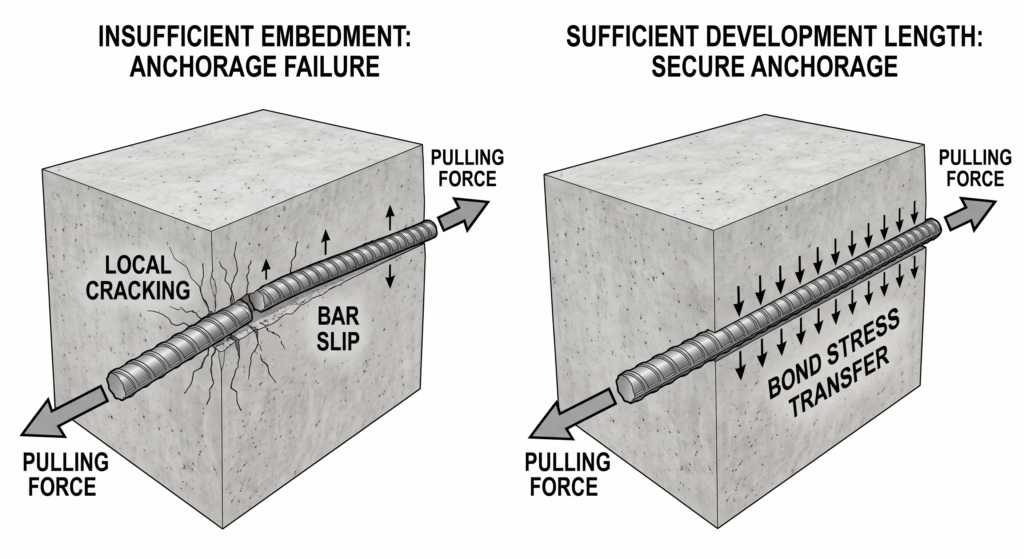
Rebar development length is the minimum length of reinforcing bar that must be embedded in concrete so that the bar can safely develop its required stress.
In simple terms, the steel needs enough contact with the concrete to transfer force between the two materials.
Imagine pulling a short steel bar out of a concrete block. If the embedded length is too short, the bar may slip before reaching its full tensile strength.
However, when the bar has sufficient embedment, bond stresses develop along its surface. As a result, the reinforcement can transfer its force into the surrounding concrete.
This bond mechanism is the basic reason development length is required.
Development Length in Simple Terms
A useful way to think about the concept is:
More force in the reinforcing bar → more anchorage is required.
At the same time:
Better bond conditions → less anchorage may be required.
Therefore, development length depends on more than bar diameter alone.
Why Rebar Development Length Matters
A reinforced concrete member can have enough steel area and still fail if the reinforcement is not properly anchored.
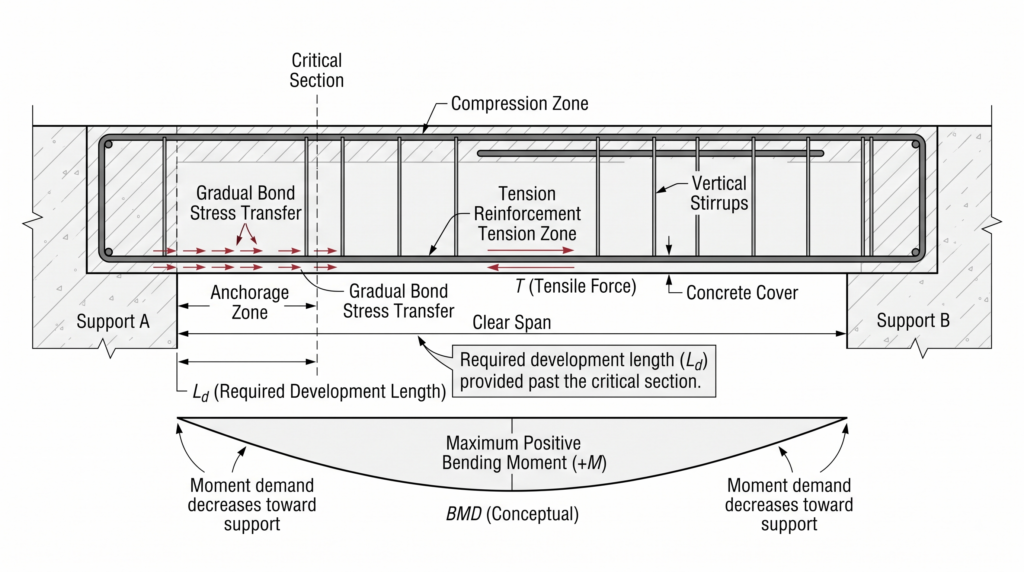
For example, consider a simply supported reinforced concrete beam. The bottom bars carry high tension near the middle of the span. However, those bars must extend far enough toward the supports to transfer their force safely.
If the reinforcement ends too early, the calculated flexural capacity may never develop.
Consequently, anchorage is not only a detailing issue. It is part of the structural load-transfer mechanism.
Poor development can lead to:
- reinforcement slip,
- excessive cracking,
- loss of flexural capacity,
- bond splitting,
- anchorage failure,
- and local concrete damage.
For this reason, engineers should check reinforcement termination as carefully as they check reinforcement quantity.
How Rebar Development Length Works
The force in a reinforcing bar is transferred to concrete through bond stresses along the bar surface.
Deformed reinforcing bars improve this bond because their ribs mechanically engage the surrounding concrete.
As the bar carries tension, bond stresses develop along its embedded length.
A simplified force relationship can be visualized as:
Steel force = Bond stress × Bar surface area over the anchorage length
Therefore, a longer embedded bar provides more surface area for force transfer.
This explains why larger-diameter bars normally require longer development lengths.
Basic Development Length Concept
For a reinforcing bar in tension:
T = As fs
where:
- (T) = tensile force in the reinforcement,
- (A_s) = reinforcing bar area,
- (f_s) = stress in the reinforcement.
That force must be transferred through bond between the steel and concrete.
Although actual design codes use more detailed equations, the physical principle remains the same:
The reinforcing bar must have enough bonded length to transfer its design force safely into the concrete.
Main Factors That Affect Rebar Development Length
Several variables affect the required rebar development length. Understanding these factors is more useful than simply memorizing an equation.
1. Bar Diameter
Larger reinforcing bars generally require longer development lengths.
This happens because the force carried by a bar increases approximately with its cross-sectional area. However, the available bond surface increases with its circumference.
As bar diameter increases, the relationship becomes less favorable.
Therefore, replacing several smaller bars with fewer large bars can create anchorage problems even when the total steel area remains similar.
2. Concrete Strength
Higher concrete strength generally improves bond performance.
As a result, stronger concrete can reduce the development length required by a design equation.
However, increasing concrete strength does not eliminate the need for proper detailing.
Cover, confinement, bar spacing, and bar location still matter.
3. Concrete Cover
Adequate concrete cover helps prevent splitting around the reinforcing bar.
When cover is too small, radial bond stresses can crack the surrounding concrete more easily.
Therefore, poor cover conditions may increase the development length requirement or limit the available bond strength.
This is especially important near:
- beam edges,
- slab edges,
- column faces,
- foundation surfaces,
- and congested reinforcement zones.
4. Bar Spacing
Bars that are too close together can increase the risk of splitting cracks.
Adequate spacing allows the surrounding concrete to confine each reinforcing bar more effectively.
Consequently, bar spacing influences both constructability and anchorage performance.
5. Transverse Reinforcement
Stirrups, ties, and other transverse reinforcement help confine the concrete around developed bars.
This confinement can improve bond behavior and reduce the risk of splitting.
For example, beam longitudinal reinforcement located inside closely spaced stirrups often has better confinement than an isolated bar near an unconfined concrete edge.
6. Bar Location
The position of a reinforcing bar during concrete placement can affect bond.
Horizontal bars near the top of a deep concrete placement may have poorer bond conditions because settlement and bleeding can occur beneath them.
Therefore, many concrete design standards distinguish between normal bars and so-called top bars when calculating development length.
7. Reinforcement Coating
Epoxy-coated reinforcement can have lower bond strength than uncoated deformed bars.
As a result, additional development length may be required.
Designers should confirm the applicable modification factors in the governing concrete design standard.
Tension Development Length vs Compression Development Length
Development requirements differ depending on whether a reinforcing bar carries tension or compression.
Tension Development Length
Tension reinforcement tends to pull away from the surrounding concrete.
As a result, bond failure and splitting can become critical.
Tension development length is therefore particularly important in:
- beam bottom reinforcement,
- beam top reinforcement over supports,
- slab reinforcement,
- cantilever bars,
- retaining wall reinforcement,
- and foundation reinforcement.
Compression Development Length
Compression reinforcement transfers force differently because the bar pushes into the surrounding concrete.
In many cases, compression development requirements are shorter than tension development requirements.
However, engineers should never assume that a short embedded bar is automatically acceptable.
The applicable code requirements still need to be checked.
Rebar Development Length in Beams
Beams are one of the most common places where development length problems occur.
Consider a simply supported beam.
The bottom longitudinal reinforcement carries tension near midspan. As the bending moment decreases toward the supports, some bars may theoretically no longer be required.
However, those bars cannot simply stop at the theoretical cutoff point.
They must continue beyond that location far enough to develop the force that exists in the reinforcement.
Therefore, engineers should distinguish between:
- where reinforcement is theoretically required, and
- where reinforcement can physically terminate.
The second location depends on anchorage and development requirements.
Beam Support Zones Need Special Attention
Near a beam support, several issues may occur at the same time:
- high shear,
- rapidly changing bending moment,
- bar cutoffs,
- limited anchorage space,
- congested stirrups,
- and beam-column joint reinforcement.
Because of this, support zones should receive extra attention during reinforcement detailing.
Rebar Development Length in Cantilevers
Cantilevers provide a useful example because the critical tension reinforcement is usually located near the top of the member.
Consider a cantilever slab or beam extending from a wall or column.
The highest bending moment typically occurs at the fixed support. Therefore, the top reinforcement must develop its tensile force inside the support region.
Simply extending the bars to the face of the support is not enough.
The engineer must confirm that adequate anchorage exists beyond the critical section.
If straight development is not possible, hooks or other approved anchorage methods may be required.
Rebar Development Length in Slabs
Slab reinforcement may look simple on drawings, but development problems can still occur.
Common locations include:
- slab edges,
- openings,
- drop panels,
- column strips,
- cantilever balconies,
- construction joints,
- and changes in slab thickness.
For example, negative reinforcement over a column must extend far enough away from the support region.
Similarly, reinforcement around an opening needs enough length beyond the disturbed area to develop its force.
Therefore, slab reinforcement should never be detailed only by following the bending moment diagram visually.
Anchorage requirements must also be considered.
Rebar Development Length in Columns and Foundations
Columns and foundations create different anchorage challenges.
Column longitudinal bars often need to transfer force through:
- floor joints,
- beam-column connections,
- column splices,
- and foundation interfaces.
At the column base, reinforcement must transfer forces into the footing or pile cap.
Therefore, the designer needs to check whether the available embedment depth is sufficient.
This becomes particularly important when:
- the footing is shallow,
- large-diameter column bars are used,
- dowels are required,
- reinforcement congestion is severe,
- or hooks are needed.
A footing may satisfy flexural, shear, and punching checks while still having an anchorage problem.
Straight Development, Hooks, and Mechanical Anchorage
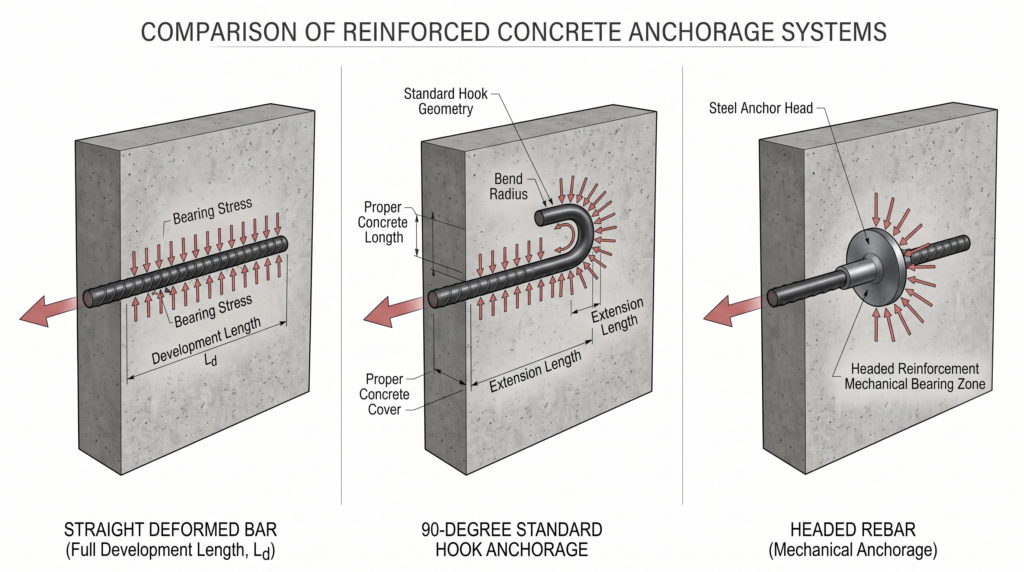
Straight embedment is not always possible.
Fortunately, engineers have several anchorage options.
Straight Bar Development
The simplest solution is to extend the reinforcing bar far enough into the concrete.
This method usually produces straightforward detailing when enough space is available.
However, large development lengths can become difficult inside narrow columns, shallow beams, or small foundations.
Standard Hooks
A reinforcing bar can also terminate with a standard hook when permitted by the governing design standard.
Hooks are commonly used at:
- beam ends,
- column bases,
- wall boundaries,
- foundation connections,
- and other locations with limited straight development space.
However, a hook does not eliminate all anchorage requirements.
Concrete cover, bend geometry, confinement, and hook embedment still need to comply with the applicable standard.
Mechanical Anchorage
Mechanical anchors or headed reinforcement can provide another solution where conventional development is difficult.
These systems can be useful in heavily congested joints.
Nevertheless, engineers must confirm that the selected system has suitable design approval and satisfies project specifications.
Development Length Is Not the Same as Lap Splice Length
Junior engineers often confuse development length with lap splice length.
The concepts are related, but they are not identical.
Development length allows one reinforcing bar to transfer its force into the surrounding concrete.
Lap splice length allows force to transfer from one reinforcing bar to another through the surrounding concrete.
Therefore, lap splice requirements may differ from basic development requirements.
In many situations, the required lap length can also increase depending on:
- the percentage of bars spliced at one location,
- reinforcement stress,
- bar size,
- concrete strength,
- bar spacing,
- and confinement.
For that reason, engineers should not automatically use the development length as the lap splice length.
A Simple Rebar Development Length Example
Consider a reinforced concrete beam with bottom tension reinforcement.
Assume the structural analysis shows that the reinforcement near a support still carries significant tensile force.
The drawing currently shows the bars ending only a short distance beyond the theoretical bending requirement.
The engineer should not immediately accept the detail.
Instead, the review should follow this sequence:
Step 1: Identify the Critical Section
Determine where the reinforcing bar must develop its required tensile force.
Step 2: Determine the Required Development Length
Calculate the required development length using the governing concrete design standard.
Consider all applicable factors, including:
- bar diameter,
- concrete strength,
- cover,
- spacing,
- bar location,
- coating,
- and confinement.
Step 3: Measure the Available Anchorage
Measure the actual bar length available beyond the critical section.
Do not measure only to the face of the support without checking how the bar is detailed inside it.
Step 4: Compare Required and Available Length
The basic check is:
lavailable ≥ lrequired
If this condition is satisfied, straight development may be acceptable.
Step 5: Modify the Detail if Necessary
If the available length is insufficient, possible solutions include:
- extending the bar,
- using a smaller bar diameter,
- providing a hook,
- improving confinement,
- modifying the member geometry,
- or using an approved mechanical anchorage system.
The final solution must comply with the governing design code.
Common Rebar Development Length Mistakes
Development length errors often happen during detailing rather than structural analysis.
Ending Bars at the Face of a Support
A support face is not automatically an acceptable reinforcement termination point.
The bar still needs adequate anchorage.
Using Only the Moment Diagram
A bending moment diagram shows where reinforcement demand changes.
However, it does not directly show where reinforcing bars may terminate.
Development and cutoff requirements must also be checked.
Ignoring Top-Bar Conditions
Top reinforcement may require additional development under certain concrete placement conditions.
Therefore, designers should identify bar location before applying a standard development equation.
Ignoring Cover and Spacing
Using the correct bar diameter and concrete strength does not guarantee adequate development.
Poor spacing or insufficient cover can reduce anchorage performance.
Assuming Hooks Solve Everything
Hooks can reduce required straight embedment, but they still need proper geometry and confinement.
Consequently, engineers should check hook requirements rather than adding hooks without calculation.
Confusing Lap Length With Development Length
Lap splice rules and development rules are connected but not interchangeable.
Always verify the specific requirement that applies.
Rebar Development Length Checklist for Junior Engineers
Before issuing reinforcement drawings, check the following:
- Is the bar in tension or compression?
- Where is the critical section?
- What stress must the reinforcement develop?
- Is the bar a top bar?
- Is the reinforcement coated?
- Is the concrete strength correct?
- Is there enough concrete cover?
- Is the bar spacing sufficient?
- Is adequate transverse reinforcement provided?
- Is the available straight embedment long enough?
- Does the bar require a hook?
- Is mechanical anchorage being used?
- Are lap splice requirements being confused with development requirements?
- Can the contractor actually place the reinforcement as detailed?
This last question is especially important.
A mathematically correct reinforcement detail can still create major problems if it is impossible to construct.
Practical Detailing Tips
Good reinforcement detailing starts before the final calculation is complete.
First, estimate whether the member has enough physical space for the expected anchorage.
Next, check congested areas such as beam-column joints and column-footing connections early.
In addition, avoid using unnecessarily large bars when smaller bars can provide similar reinforcement area with easier anchorage.
Finally, review reinforcement drawings in three dimensions whenever possible.
Bars from beams, slabs, columns, walls, and foundations often compete for the same space.
Therefore, an anchorage solution should work both structurally and geometrically.
Why Junior Engineers Should Understand the Mechanism
Design software can calculate reinforcement requirements quickly.
However, software does not always show whether reinforcement can actually develop the calculated force inside the available geometry.
That responsibility remains with the engineer.
Once you understand the physical mechanism, development length becomes easier to review.
Instead of asking only:
“How much reinforcement do I need?”
you begin asking:
“Where does this reinforcement force go, and is there enough length to transfer it?”
That question is fundamental to reinforced concrete design.
Final Thoughts on Rebar Development Length
Rebar development length connects structural analysis with reinforcement detailing.
A reinforcing bar can contribute its full design strength only when that force can transfer safely into the surrounding concrete.
Therefore, engineers should check development whenever reinforcement:
- starts,
- stops,
- changes direction,
- crosses a joint,
- enters a support,
- connects to a foundation,
- or overlaps another reinforcing bar.
For junior structural engineers, one practical habit can prevent many detailing mistakes:
Never check only the amount of reinforcement. Always check where the bar force goes and how the bar is anchored.
That approach leads to safer designs, clearer drawings, and fewer reinforcement problems on site.
Frequently Asked Questions About Rebar Development Length
What is rebar development length?
Rebar development length is the minimum embedded length needed for a reinforcing bar to transfer its required force into the surrounding concrete through bond.
Does a larger reinforcing bar need more development length?
Generally, yes. Larger bars carry more force relative to their bond surface and therefore usually require longer development lengths.
Can a hook replace straight development length?
In some situations, a standard hook can provide the required anchorage when straight embedment is limited. However, hook geometry, cover, confinement, and code requirements still need to be checked.
Is development length the same as lap splice length?
No. Development length transfers force between reinforcement and concrete, while a lap splice transfers force between overlapping bars through the surrounding concrete.
Where should development length be checked?
Typical locations include beam supports, bar cutoffs, cantilever supports, slab edges, openings, beam-column joints, column bases, foundations, and reinforcement splices.
Can structural design software check development length automatically?
Some programs provide reinforcement detailing or anchorage checks. However, engineers should still review the actual bar geometry, available embedment, cover, spacing, confinement, and constructability.