
Transitioning from Site to Office: The Question “Why?”
In 2005, I began my career at a construction company. While I enjoyed the dynamic environment of the field, one question constantly haunted me: “Why was it designed this way?” I realized that to be a truly exceptional builder, I first needed to understand the logic behind the design. Driven by this curiosity, I made a bold move—I left the construction site and joined a Plant Engineering design firm.
Day 3 of Despair: 2,000 Pages of Drawings and Unknown Terms
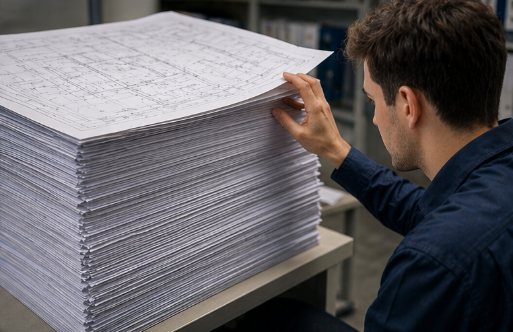
As a newcomer who barely knew what “Plant Engineering” truly entailed, my senior handed me a massive bundle of nearly 2,000 pages of drawings. “Review and memorize these,” he said. Confronted with complex diagrams and technical jargon that looked like a foreign language, I felt overwhelmed.
By the third day, I seriously considered quitting. However, a voice inside told me, “Endure and learn.” Back then, junior engineers weren’t even allowed to touch a computer; we had to master the drawings by hand and eye first. I read those pages over and over, like a student studying a textbook.
A Mentor’s Insight: “A Top Engineer Speaks Through Drawings”

On my fourth day, my senior noticed my struggle and offered a piece of advice that changed my perspective forever:
“It’s okay if you don’t understand yet. No one does on day one. But remember: a great engineer isn’t just someone who performs complex calculations. A truly great engineer is someone who creates drawings that even a complete novice can understand. Calculations are just the process—the final language of an engineer is the drawing.”
In that moment, the drawings were no longer just a collection of lines. They became the ‘Ultimate Language’ used to communicate an engineer’s intent to the field.
The Danger of Being a “Half-Baked” Engineer

For the next three years, I immersed myself in drawing work. I learned why a specific line had to be drawn, why a particular note was essential, and why scale mattered so much.
Today, I often see engineers who dismiss drawing work as “something for CAD operators.” They think, “I am a structural/geotechnical engineer; I just need to provide the calculations!” This is a grave mistake. An engineer who doesn’t understand the basics of a drawing is a “half-baked engineer” who cannot ensure their design is properly executed in the real world.
Conclusion: Creating Something from Nothing
Plant structural design doesn’t start with fancy software; it starts on a blank sheet of paper. This “From Zero to One” process of creating drawings is the essence of engineering. To all junior engineers: Focus on every line and every number on the drawing in front of you. That is the first step to becoming a ‘Real Engineer.’
FAQ for Global Audience:
- Q: Why should design engineers learn to draft? A: Because the drawing is the only way your design intent is communicated to the construction team.
- Q: What is the most important part of a drawing? A: Clear notes and ‘Constructability’—ensuring the design can actually be built on-site.
- Q: How can I improve my drawing review skills? A: Cross-reference standard drawings with international codes like AISC or API.